Water-damaged drywall
Wet, swollen or stained board after a flood, a burst line or a slow leak, trimmed back until only firm board remains, then rebuilt.
Read about water-damaged drywallDented, cracked, soaked or sagging? Ring the number above, or text in a photo, and hear a price before a single screw comes out.
Doorknob holes, cracked plaster, leak rings and ceilings that have started to droop, rebuilt and textured level with the wall beside them, so the repaired spot fades into the room once painted.
Your call starts it: describe the damage once, and a nearby pro names a figure ahead of any work.
Call 7 days, 7am–9pm
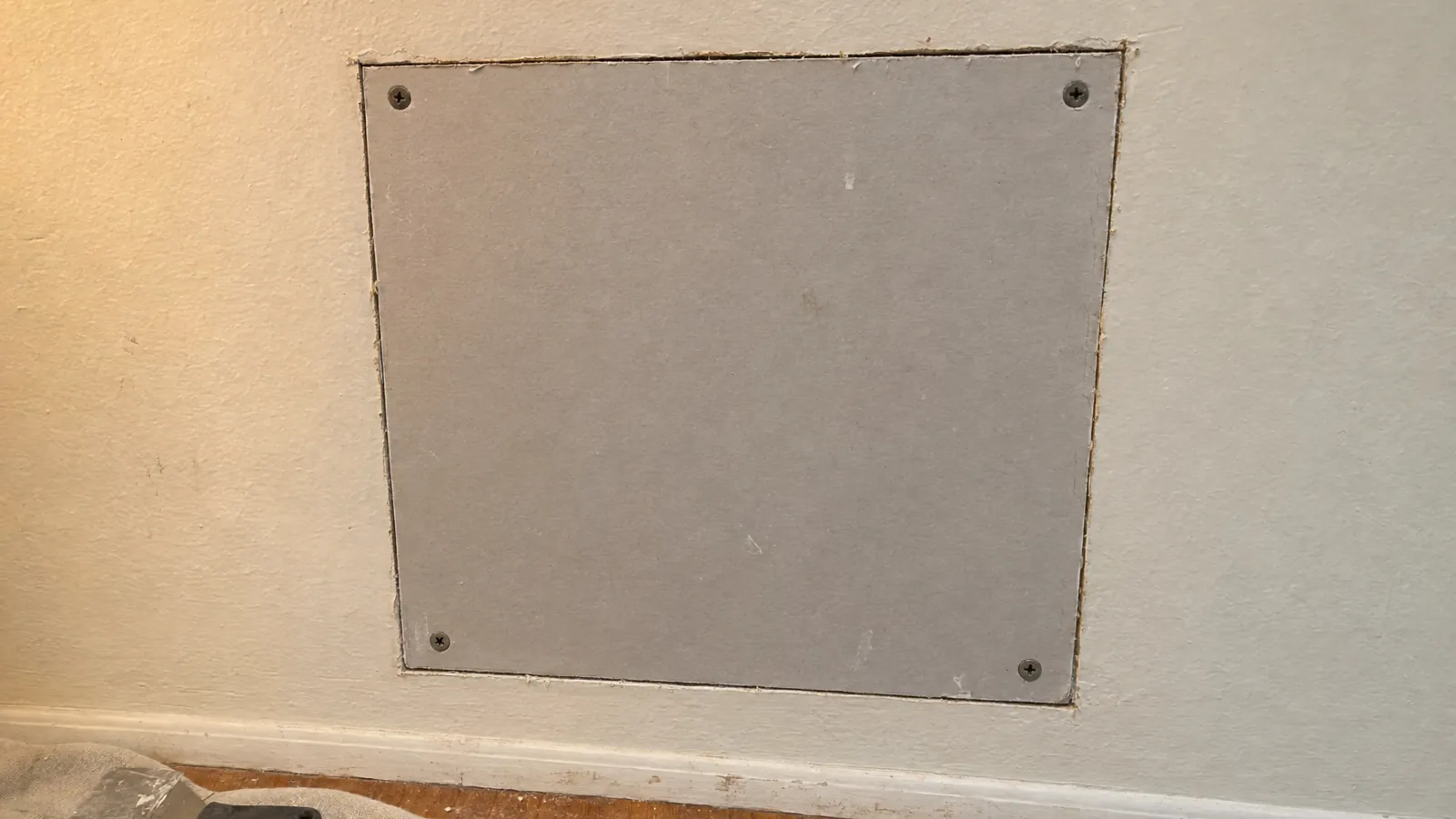
Which fix fits your wall? Two things decide it: how much of the board is damaged, and what shape the surface around it is in. Here is the trio laid out against each other, so a quote that names one of them makes sense to you.
| Compared on | Cut-in square | Fresh sheet | Skim coat |
|---|---|---|---|
| Fits best when | One hole or soft spot no bigger than a dinner plate | Board is swollen, moldy or broken across a broad stretch, typical after floodwater | The wall is solid but scarred, rough, or freckled with old patch outlines |
| How much board comes off | A tidy square around the damage | A whole panel, or everything under one level cut line | None; mud is spread over the face already there |
| Mud coats | Three is typical, each left to dry | A bedding coat on the tape, then a pair of finish coats on every joint | Two or three skims spread across the entire wall |
| Texture | Sprayed or troweled in a ring around the square | The full wall is textured to look like its neighbor | Leaves a fresh, even face, so less needs copying |
| Dust and upheaval | Light: one small spot to sand | Heaviest: cutting, hauling old board out, sanding long joints | Middling: the entire wall gets a light sanding |
This Old House, in its June 2026 drywall cost write-up, lists $60 to $200 as a typical pro charge for a small hole, and notes that bigger jobs tend to be billed by the hour ($60 to $100) or by the square foot ($50 to $80). Treat those as countrywide averages; nobody has priced your wall yet. Your number moves with the extent of the damage, the texture, the ceiling height, and whether whatever caused the damage is still going on.
A patch can only be as solid as the gypsum it's screwed into. If the edges of a hole are punky from water or breaking apart, mud spread over them cracks or blisters later. The sound approach trims back until the board is firm all around, even when that makes the opening larger, then cuts the new piece to fit.
Damage tends to point at its own cause. Open the description nearest to yours to see the likely culprit and which repair page deals with it.
Corners of openings are where a house's framing bunches up its stress, so settling, seasonal swelling and shrinking, or a door that gets slammed a lot all show up as a slanted line off the corner. The fix widens the crack a hair, spans it with tape and spreads mud far enough out that the edges fade into the wall. See fixing cracked plaster and drywall.
Almost always a taped seam giving up: the paper tape has let go of the mud under it, or the framing shifted far enough to rip it. Caulk and paint won't keep it shut. The loose tape gets peeled off and the seam is re-taped and refinished. Seams are covered on the same crack repair page.
Nail pops. As the studs behind dry and shrink, nails creep outward and shove their dab of mud off the wall. A screw sunk alongside each one pulls the board back tight, the nail is driven deeper or pulled, and both get spotted over. Covered under patching holes, dents and nail pops.
Water arrived from above: the roof, a supply or drain line, an air conditioner's condensate drain, or the bathroom of the unit upstairs. A ring that's dry doesn't prove the drip has stopped, so the source is tracked down first. Living in a condo or the downstairs half of a two-family? Read ceiling leaks from the unit above.
Board along the floor can wick water up from a flooded room or damp basement, and the gypsum may be mush behind paint that still looks fine. Push on it gently; if it gives, it gets cut out. Go to repairing water-damaged drywall.
Kill the circuit feeding whatever fixtures and fans hang in that section of ceiling, and then clear everybody out of the space beneath it. A belly usually means water is pooling on the upper side of the board, or the screws have torn through. Either way, the sagging section is removed and new board goes up; pushing the old board back into place doesn't work.
Something struck the wall: a doorknob, the corner of a dresser, a dolly on moving day. Little ones get filled; bigger ones get a square of new board, like the screwed-in square pictured earlier on this page. The frayed paper around the edge is trimmed off first so it can't blister under the mud.
Which page fits your wall? Start with the cause of the damage: water, movement, a leak from the home above, or an impact.
Wet, swollen or stained board after a flood, a burst line or a slow leak, trimmed back until only firm board remains, then rebuilt.
Read about water-damaged drywallSettling cracks, split seams and cracked plaster opened, taped and blended back into the surface.
Wall and ceiling crack repairCeilings stained or soaked from the unit above, repaired after the drip upstairs is stopped.
Condo ceiling leak repairDoorknob holes, anchor holes, dents and nail pops filled or patched, then textured like the wall around them.
Drywall patching for holesWhat should you do the moment water reaches a wall or ceiling? Here is the order that protects the house and keeps the repair smaller. The Peckman River meets the Passaic River here in the borough, and the borough has said Peckman flooding has caused multiple flash floods in Woodland Park and Little Falls, so it's worth knowing before you need it.
Close the main shutoff for a burst line, or the valve under a leaking fixture. If the water is coming from the unit upstairs, knock on their door and call the building manager or association. After a flood, wait until the room is safe to enter and the electricity in wet areas is off.
Before anything else, flip the breaker serving the fixtures and fans in that patch of ceiling, then keep people and animals clear of the area below. With the power off and the room empty, a pail set where the sag hangs lowest catches the drips. Soaked board carries a lot of weight and can come down all at once.
Get air moving with box fans, run a dehumidifier, pry off wet baseboard and pull soaked insulation from any opened cavity. Gypsum gives up water slowly through its painted face; opening the wall behind it shortens the wait considerably. Photograph everything before it's carried out, for the insurance claim.
Compare readings from a pin-type meter on the wet area with readings on a dry wall elsewhere in the house; when they line up, the framing is ready. Sealing a cavity while studs are still damp gives mold a dark, wet place to grow behind the new board.
Gypsum that is mushy, flaking, puffed up along its bottom edge or freckled with mold gets removed. So does board that stood in floodwater, which brings along whatever the river and the street were carrying. Most often the cut runs level, a foot or two higher than where the water reached. More on this under water-damaged drywall repair.
What counts most before a landlord's final inspection or a listing shoot? Whatever a camera or an inspector catches first: holes at eye height, dents behind doors and anchor holes left by a TV mount. The Census Bureau's 2020 to 2024 survey puts renters in 1,997 of Woodland Park's 5,399 occupied homes, so plenty of households here go through a final inspection sooner or later.
Anything visible from a doorway: holes, doorknob dents, paper torn off where an adhesive hook was pulled, crushed metal on outside corners, and water rings on ceilings. Rings need a stain sealer under the paint; plain paint usually lets the brown seep back through.
Pinholes a painter fills during prep, scuffs that wipe off, and hairlines in old plaster that open in winter and close again by summer. Unsure? Text a photo and ask.
Drywall comes first. Mud must be bone dry, and patched spots get a coat of primer, or they show through the finish paint as flat, dull blotches. Mention the painter's start date when you get in touch so drying days get built into the plan.
Mention the date up front. Setting-type mud, the powder kind, cures by reacting with its water instead of by air-drying, which trims the gap between coats. Whether it suits your repair comes down to its size and how many coats it takes.
Do you live just outside the borough? Repairs are arranged in the towns around Woodland Park too. Garret Mountain Reservation, the county park that sits mostly inside the borough, also reaches into Paterson and Clifton.
Why does it matter what your wall is made of? Because a repair only blends in when it uses the same kind of board and ends up with the same surface as the wall around it.
Half-inch gypsum panels cover most interior walls. Ceilings, and fire-separation walls such as the one dividing a garage from the living space, often get thicker 5/8-inch fire-resistant board. Bathrooms may have moisture-resistant panels. A patch has to match the thickness or it stands proud of the wall or dips below it. Older houses may be plaster instead, which gets a different repair.
Bucket mud is premixed and air-dries, overnight as a rule. Hot mud starts as a bag of powder; stirred into water, it cures chemically in the number of minutes printed on the bag, and it shrinks less, so it goes into deep fills and first coats. Plenty of repairs use both: hot mud underneath, bucket mud on top because it sands more easily.
Smooth walls need wide, flat feathering. Orange peel is a fine spray of droplets; knockdown is a heavier splatter knocked flat with a trowel. Popcorn ceilings are a sprayed-on acoustic coating. Matching means practicing the spray pattern on scrap cardboard first. Old popcorn can hold asbestos; test it before any sanding or scraping.
For more depth, read the guide to repair materials.
What does the repair itself involve once it's booked? Most jobs follow the same sequence. How many days it spans depends on how many coats the damage needs and how fast they dry.
Canvas or plastic goes over the floor, and anything parked against the wall is shifted or draped. Clearing a few feet around the damage yourself speeds this part along.
Frayed paper is trimmed, mushy gypsum is sawn out to a clean square, and wood or metal backers are fastened behind the opening to give the replacement piece a place to take screws. Cracks are widened a little so mud can bite into them.
Paper or mesh tape bridges every seam and crack, bedded in mud. This coat is about strength, not looks.
Each coat must dry or set before another is added. Two or three coats are normal, every one reaching a little wider than the coat under it. Muggy weather and chilly rooms slow drying down.
Almost all the dust comes from sanding. Plastic taped over doorways, a vacuum hooked to the sanding head, or wet-sanding small spots with a sponge all cut it down. If dust worries you, ask the pro which approach they'll use.
The surrounding texture is reproduced over the repair, and the area is then ready for primer and paint. Ask whether primer is included in the price, and who handles the final coat of paint: you, a painter, or the pro.
Does the weather really affect drywall? Yes, mainly through moisture and temperature swings. NOAA climate normals for 1991 through 2020 at Newark Liberty International Airport, the closest long-running official weather station, count how many nights each month drop to 32°F or lower.
When the heat runs for months, indoor air dries out and so does the framing. Lumber shrinks, nails back out, and seams and corners open up. Winter is also when pipes in outside walls freeze and split, and when ice that builds up at the eaves can back meltwater beneath the shingles and down onto the ceiling of an upstairs room.
July is the wettest month in those Newark normals, at 4.66 inches. Heavy downpours overload gutters and send water toward foundations, and the remnants of Hurricane Ida in September 2021 caused significant damage in the borough.
Bathrooms without a working fan, closets on outside walls and finished basements hold moisture through the summer. Mildew on paint and soft spots at the base of a wall are signs the board has been damp for a while.
Own a rental here? 1,411 of the borough's homes sit in two-unit buildings (Census Bureau, 2020 to 2024 survey), a total topped only by single-family detached houses. Here are the questions owners of those buildings tend to ask.
Yes, and at a turnover it usually makes sense. List every room and every repair when you get in touch, or walk through with your phone and send photos of each one. One trip for all of it costs less to arrange than several.
Pass along the tenant's contact details and the times that suit them, and give them the notice your lease calls for. Tell the tenant what to expect: some dust, drop cloths, and a second or third day for coats.
In a two-family house, a ceiling stain downstairs is often a bathroom upstairs. The source gets fixed before the ceiling, or the new board will stain too. Who pays is between the owners and their insurers; the repair is the same either way.
Is your house older than it looks? Close to two in three of the borough's 5,534 homes went up before 1980, according to the Census Bureau's 2020 to 2024 American Community Survey, and 1,224 of the homes still standing are from the 1960s, the biggest single decade.
Of the borough's homes, 598 predate 1940, and a house that old may well have plaster walls. Plaster cracks in long runs and can detach from the wood strips behind it. A sound repair pins loose plaster back with plaster washers and bonds new material to the old before any finishing coats.
By mid-century, gypsum board had largely taken over from plaster in new houses. Six decades of settling show up as cracked seams, nail pops and corner cracks, which respond well to re-taping and screws.
Federal EPA rules on lead-safe work cover paid jobs that disturb paint in housing from before 1978. Sanding and cutting old painted walls makes dust, so ask the pro how that dust will be contained and cleaned up.
What happens when you send this? We read it; then a local drywall contractor phones to hear more about the damage and price the job. Nothing goes on the calendar until you've seen that price.
(862) 396-3889Call 7 days, 7am–9pm
Hitting send OKs phone calls or texts about it from Woodland Park Drywall Repair plus the local drywall pro who quotes it. Where your details go
What follows: a nearby drywall pro phones you, hears about the damage and works out a figure for the repair.